
On 25 July 1928, a man pulled up outside the General Post Office on Elizabeth Street, Melbourne, having just finished one of the great drives of the twentieth century. A policeman promptly asked him to move on for obstructing traffic. That was the welcome waiting for Francis Birtles, the first person to drive a car from England to Australia.
It is a slightly deflating end to an eight-month epic, and it tells you something about the man. Birtles spent decades going places where nobody had built a road, and then he had to find somewhere legal to park. Our team reckons he is the most under-celebrated figure in Australian touring history, and with caravan and 4WD travel booming, he deserves a proper look.
A bootmaker's son who jumped ship
Francis Edwin Birtles was born on 7 November 1881 in Fitzroy, Victoria, the third child of David Edwin Birtles, an English bootmaker, and Sarah Jane Bartlett. Nothing about that start points to a life on the road. At 15 he joined the merchant navy as an apprentice, and when the Second Boer War broke out he jumped ship at Cape Town in 1899, hoping to enlist with Australian militia. The Wikipedia biography of Francis Birtles tracks the whole career, and much of what follows draws on it.
It did not go to plan. He ended up attached to the Field Intelligence Department as part of a troop of irregular mounted infantry, and he stayed until May 1902. After a short spell back in Australia he joined the constabulary as a mounted police officer in the Transvaal. That ended when he contracted blackwater fever.
So by the time he was back at Fremantle, he had already seen what it takes to keep going a long way from home, and what it costs when illness strikes. Illness would follow him on later trips too. In 1915, partway through a long drive, he spent two weeks in Adelaide recovering before pushing on.
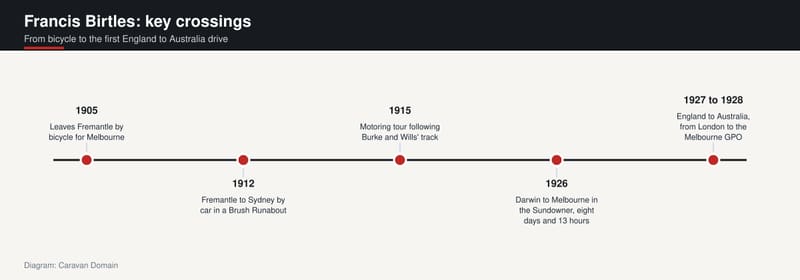
Fremantle is where the Birtles story really begins. His first great crossing was not by car at all. It was by bicycle.
Two wheels across a continent
On 26 December 1905, Birtles left Fremantle to cycle to Melbourne. It drew widespread attention because it was the first west to east bicycle crossing of the country. After a short stretch working as a lithographic artist, he was off again in 1907 and 1908, cycling to Sydney and then looping through Brisbane, Normanton, Darwin, Alice Springs and Adelaide before returning to Sydney, where he based himself.
That route alone is a map of how big the country is. Try joining those towns on a road atlas and you will see why people noticed.
In 1909 he published the story as Lonely Lands, illustrated with his own photographs. That same year he set a new cycling record for the Fremantle to Sydney crossing. In 1910 and 1911 he rode right around Australia. In 1911 a cameraman, R. Primmer, from Gaumont, accompanied him from Sydney to Darwin, and Birtles carried on to Broome and Perth. Then he broke his own record by riding from Fremantle to Sydney in thirty-one days.
By 1912, according to the record, he had cycled around Australia twice and crossed the continent seven times. He was not yet 31.
We find that number worth sitting with. Seven continental crossings, and a pair of laps right around the country, all inside about seven years of that first ride from Fremantle. Whatever overlanding is, he was practising it before the word had its current meaning.
The man with the movie camera
Birtles was never just a record chaser. He was a photographer and a filmmaker, and our view is that he understood early that a crossing nobody saw was a crossing nobody would talk about.
The Gaumont trip produced a film, Across Australia, released the following year. More followed. The list of his films includes Across Australia with Francis Birtles (1912), Into Australia's Unknown (1914), Across Australia in the Track of Burke and Wills (1915), Through Australian Wilds (1919) and Coorab in the Island of Ghosts (1929). A final credit, That Certain Something, is listed for 1941, the year he died. Several of the films record his encounters with the outback and with Indigenous Australians.
He wrote as well as filmed. Alongside Lonely Lands came a 1913 account of a Gulf of Carpentaria to Port Phillip Bay drive in a Ford, a 1924 booklet on a Darwin to Adelaide run, and in 1935 Battle Fronts of Outback, published by Angus and Robertson. In that last book he described more than 70 transcontinental crossings completed by mid-1927.
If you have ever filmed a camp setup for friends, or posted a river crossing to a travel group, you are in his tradition. In our view, he was among the first Australians to treat the journey itself as the story.
Cars before roads
The move from bicycle to motor car came in 1912. Birtles became one of the first people to make a west to east crossing by car, from Fremantle to Sydney in a Brush Runabout, with driver Syd Ferguson. Not long after, on 21 September 1912, he left Melbourne in a blue 20 hp Flanders touring car with his brother Clive and a bulldog called Wowser. The plan was Sydney, Brisbane, Charters Towers and then the Gulf of Carpentaria. From the Gulf he drove close to the Northern Territory border, and he arrived back in Melbourne in January 1913.
Then came the trip that most closely matches what modern travellers would call an expedition. On Saturday 13 February 1915, Birtles left Sydney on a motoring tour following the track of Burke and Wills, with a movie camera on board. He reached Broken Hill on 25 February and Adelaide on 1 March. After his rest there he drove through Burra, Port Augusta, Quorn and Maree to Cooper Creek, and reached Normanton on Saturday 5 June.
From there he went on via Cape York, Einasleigh, Hughenden, Tambo, Roma, Toowoomba and Brisbane, arriving in Melbourne at the end of September. He had covered 7,000 miles in seven months. A final leg to Swan Hill and Menindee finished the footage, and the film opened at Hoyt's Olympia Theatre in Melbourne on Christmas Day 1915.
Think about that itinerary the next time a navigation app says "recalculating". If you enjoy stories of dirt that still tests people, our feature on the Canning Stock Route covers another route that was never meant to be easy.
Sundowner: Darwin to Melbourne in eight days
By the mid-1920s Birtles had a new kind of backer. Barlow Motors, the Melbourne agent for Bean cars, commissioned him as a publicity stunt to drive a modified Bean 14 from Darwin to Melbourne. The sponsor list reads like an early version of today's overland build sheets. The British Imperial Oil Company supplied fuel, Sir Charles Wakefield supplied the Castrol, and Dunlop Rubber supplied the tyres.
With co-driver Alec Barlow, Birtles left Darwin at 4 am on 23 October 1926. They completed the 5,440 km journey in eight days and 13 hours, a record. The car was dubbed the Sundowner.
Compare that with the 1924 booklet on his Darwin to Adelaide run, which was titled with a time of nine days, nine hours and fifteen minutes, and the dates 18 to 27 November. It is a neat reminder that he kept returning to the same stretch of country and publishing the results.
We should be careful about reading too much into a record, though. A stunt run with fuel, oil and tyres supplied is not the same as a private traveller setting off with a swag and a prayer. Still, the publicity was the point, and Birtles delivered it.
If you want a sense of how a very different kind of remote country is crossed today, our look at the Simpson Desert crossing is a good companion read.
England to Australia, the long way
Success in the Sundowner led to the big one. Birtles was asked to attempt to become the first person to drive from England to Australia. He set off from Australia House in London on 19 October 1927, seen off by a crowd of well-wishers that included the 1927 Miss Australia.
The record describes an era with few roads and sparse petrol supplies. Over about eight months, the journey carried him across mountains, deserts and tropical jungles, and included several sea voyages, the last from Singapore to Darwin. His route took in Europe, Egypt, Persia (now Iran), India, Burma and Malaya.
Then, at the end of the sea voyages, came bureaucracy. When he arrived in Darwin, customs officials seized the car, demanding import duty. Only the direct intervention of Prime Minister Stanley Bruce sorted it out. Birtles carried on south through Brisbane and Sydney, finishing at the Melbourne GPO on 25 July 1928, and the policeman took it from there.
Nobody repeated the drive until 1955. That gap says a great deal about how hard it was, and about how far ahead of his time he travelled.
Our team's honest opinion is that the customs episode is the most Australian part of the whole saga. A man covers continents, and the obstacle in the end is paperwork at the front gate.
What overlanding owes him
Here is a small bit of vocabulary. According to the Wikipedia entry on overlanding, the word was historically an Australian term for droving livestock over very long distances to open up new country or to take stock to market. Alfred Canning opened up his stock route between 1906 and 1910. The modern sense, self-reliant travel to remote places where the journey is the goal, arrived later, and the same source credits Len Beadell's road building in the 1940s and 1950s with inspiring much Australian overlanding.
Birtles sits between those two eras. He was not a drover, and he was not a road builder, but he was out there in motor vehicles, at a time when most people could not imagine it. What he left behind is a template. Seek a sponsor for the hard bits. Document everything. Be ready for illness, for customs officials and for a lot of empty distance.
The overlanding page also notes that the modern form began in the middle of the last century with commercially available four-wheel-drive trucks, and that "there were a few earlier pioneers travelling in remarkably unsophisticated vehicles." Birtles fits that description to the letter.
Today's travellers have it easier. A modern off-road caravan is built for this kind of country in a way nothing in 1915 was, and our story of the Unimog expedition camper shows how far purpose-built overland kit has come. For a trip on corrugations that are still genuinely remote, the Gibb River Road is a reminder that proper dirt is not extinct. As always with remote driving, check current conditions and requirements with the relevant authorities and get proper advice before you go.
Gold, a long goodbye and a car in a museum
Birtles's later years were quieter, although he never quite stopped. In 1933 he travelled to Arnhem Land with a prospecting and mining expedition, looking for gold he had found several years earlier on one of his journeys. He sold his share in the mining stake and retired a wealthy man.
He was married twice. He married Frances Knight in November 1920 at St Paul's Cathedral, Melbourne, but they separated soon afterwards and she divorced him in 1922. In 1935 he married Nea McCutcheon at St Mary's Cathedral, Sydney, and they stayed together until he died on 1 July 1941 at Croydon in Sydney, of coronary vascular disease. He is buried in the Anglican section of Waverley Cemetery.
The Bean car has had its own odd afterlife. In 1929 it was presented to the Australian Government on condition that it be placed in the national museum. There was no such museum at the time, so the car disappeared for many years. It was recovered in the 1960s, went into the National Motor Museum in Adelaide in 1980, and moved to the National Historical Collection of the National Museum of Australia in Canberra in 2001.
We like that. A machine built to beat the clock sat forgotten for decades, then ended up where it belonged. If you plan a visit, check the museum's current display details first.
Perhaps the best way to think of Francis Birtles is as the person who showed that the continent could be crossed by car, and who made sure that people at home saw the proof. The next time you pull up somewhere remote and a stranger asks you to move along, take it as a compliment. He got the same treatment.
If his story has you itching to plan a trip of your own, browse caravans and RVs for sale and see what could carry you a little way along his tracks.
Sources
- Wikipedia, Francis Birtles, accessed 13 November 2026
- Wikipedia, Overlanding, accessed 13 November 2026
