
Australia is made for road trips, and its distances are the reason a touring holiday can cost more than you planned. The costs that grow fastest once you leave the city are the ones you can steer: fuel, a place to sleep each night and the timing of your trip. This guide shows how to travel Australia on a budget, whether you drive your own car and pitch a tent each night or tow a caravan behind it. It leans on the official tools the states run and on what their agencies publish, so you can check each point for yourself before you set off.
How to travel Australia on a budget: start with the set-up
Most of what a trip costs is decided before you leave home, by the way you choose to travel. Flying between cities and hiring a car at each end can suit a short holiday with fixed dates, but then every night needs a bed that you pay for. A road trip in something you can sleep in, or with a van you tow, turns that nightly bill into the price of a campsite, and on a long loop that difference adds up night after night.
There is no single right set-up. If you already own a car, a tent lets you start touring without buying a second vehicle. If you are weighing up something bigger, compare the campervans for sale and the camper trailers for sale on Caravan Domain before you decide.
A caravan gives you more room, but it adds weight behind the car. The Australian Government's Green Vehicle Guide lists the load a vehicle carries or tows among the factors that change how much fuel it uses on the road 1. Before you buy a van, check it against your vehicle with our tow match tool, which shows the caravans whose ATM sits within your vehicle's rating.
Set a daily budget and track it
A budget for a long trip works best as a daily figure, because that is the scale at which you spend money on the road. Work out a total for the whole trip, then turn it into a daily amount that covers the costs that come back day after day:
- fuel for the distance you plan to drive
- a campsite or a caravan park each night
- food, including any meals you eat out
- park passes, entry tickets and activities
- a buffer for repairs and other surprises
Write down what you spend each evening and compare it with your daily figure. A day over budget is easy to fix with a quiet day or a simpler campsite the next night, while a week over budget is much harder to win back. Keep the buffer separate from the daily amount, so one flat tyre or an unplanned service in a remote town does not push the rest of the trip off track.
It can also help to set aside a smaller sum for the things you most want to do. That way, what you save on fuel and sites pays for the highlights instead of disappearing into the general spending.
Fuel: compare prices with the official tools
Several states now publish service station fuel prices through government schemes, so you can compare them before you fill up and plan your stops around the cheaper towns on your route. If you want to see how the schemes work, the NSW FuelCheck tool and Victoria's fuel price reporting rules are good places to start.
New South Wales and Victoria
In NSW, the government's FuelCheck tool lets you find and get directions to the cheapest fuel near you and across the state, and compare the prices of each fuel type, from diesel to LPG 3. It is an offence for a NSW service station not to notify the standard retail price of a fuel it sells 4.
Victoria publishes its prices through Servo Saver, in the Service Victoria app 5. Retailers there must report a price change within 30 minutes, and each day they submit the next day's maximum price by 2 pm, which is published on Servo Saver by 4 pm and from 6 am becomes the highest price they can ask for that fuel for the next 24 hours 5.
Queensland and Western Australia
Every fuel retailer in Queensland must report its normal fuel prices and any changes to them within 30 minutes of the price changing at the bowser, and that information reaches drivers through fuel price websites and apps 6.
In Western Australia, retailers notify FuelWatch of the next day's price by 2 pm, and that price must stay the same for 24 hours from 6 am 7. In April 2026, the WA Government announced that reporting to FuelWatch would become mandatory for every fuel retailer in the state from 1 May 2026 7. The state's consumer protection office advises against staying loyal to one brand, because prices can vary from site to site on any day 8.
Drive for economy
How you drive matters as well as where you fill up. The Green Vehicle Guide says a car travelling at 110 km/h can use up to a quarter more fuel than it would at 90 km/h, and that carrying less cargo can reduce fuel consumption 2. That counts for more when you tow, because the guide also lists the load a vehicle carries or tows as one of the factors that change its fuel use on the road 1. Pack what you need for the trip and leave the heavy extras at home.
Cheaper places to sleep
Where you sleep is the other big daily cost, and the parks run by the states are a good place to start. Each state does things its own way:
- In NSW, you pay to drive into only 45 of the more than 890 national parks and reserves, the payment is per vehicle rather than per person, and entry on foot or by push bike is free 9.
- In Tasmania, a valid parks pass is required to enter the national parks, so add the pass to your budget before you go 10.
- In Queensland, you must book and pay for a camping permit before you arrive at a camping area in the state's parks and forests 11.
- In Victoria, Parks Victoria's where-to-stay map shows the campgrounds where you need to book in advance 12.
When you need mains power and hot showers, a caravan park is the place to go. Ask whether the park has a weekly rate if you plan to stay put for a while, and book early if your dates fall in the school holidays.
On long driving days, plan your breaks around rest areas. The NSW Government advises planning a stop at a rest area every two hours to manage fatigue and keep your passengers comfortable 13. Check the signs at a rest area before you plan to stay the night there.
Travel outside the peaks
If your dates are flexible, travel outside the school holidays, and remember that each state sets its own dates. In 2026, for example, Victorian schools finished their second term on Friday 26 June and started the third on Monday 13 July 15, while NSW public schools in the eastern division had their winter holidays from Monday 6 July to Friday 17 July 14. The two breaks shared only one week, so between them the two states had school holidays across three weeks 1514.
For the coming summer, NSW eastern division schools are on holiday from Friday 18 December 2026 to Wednesday 27 January 2027 14, and Victorian government school students start the 2027 school year on Thursday 28 January 15. Check the calendar of every state you plan to pass through, not just your own.
In the north, the season matters more than the school calendar. The Bureau of Meteorology describes the yearly swing from the dry season, from May to September, to the wet season, from October to April, with the monsoon typically arriving in late December and continuing to around March 16. Plan a northern loop for the dry months. If you go in the wet, allow for heavy rain and for plans that may change with it.
Volunteer your way to a free campsite
If you can give some time, volunteering can cover the cost of your site. Parks Victoria's campground hosts are a friendly contact point for visitors and park staff at popular campsites, and in return they can camp for free and are given a uniform and support while they are in the park 17.
Applicants must be 18 or over 17. A National Police Check is required, and Parks Victoria pays for it 17. A Working with Children Check is also needed, and it is free for volunteers 17. Hosts need a good level of fitness, because some of the campsites are in remote locations 17. To take part, you register as a volunteer on Parks Victoria's ParkConnect site and join the campground host group, which tells you when recruitment opens 17.
Low-cost days out
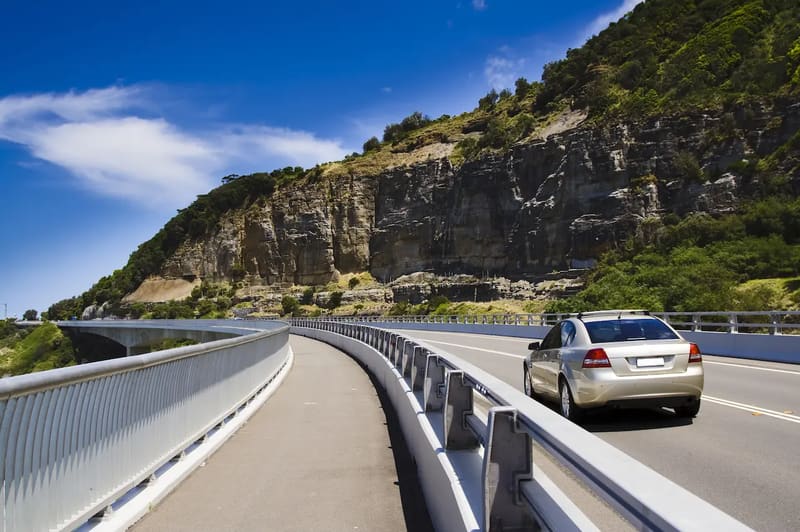
Many of the best days on a road trip cost little more than the fuel to get there. Scenic drives are the obvious example. The Grand Pacific Drive in NSW runs from the Royal National Park at Loftus down to Nowra, and its 665 metre Sea Cliff Bridge at Coalcliff opened in December 2005 18. The NSW Government describes the bridge as a chance to get out of the car and stretch your legs, and if you arrive by train, the walk from Coalcliff station takes about 15 minutes up a steep incline 18.
Walking is free in more places than you might expect. Entry to NSW national parks on foot or by push bike is free, even in the parks that ask for a vehicle payment 9.
Families can look for activities led by rangers. Parks Victoria's Junior Rangers activities are free to join and are designed for primary school aged children, and they run in parks across Victoria during the school holidays 19. Our family camping tips have more ideas for travelling with children.
If you like to stay active on the road, Parks Victoria describes parkrun as a free weekly community event where you can walk or run a 5 km course every Saturday morning at 8 am 20. You sign up online once and bring your barcode each week 20. There is more on keeping fit while you travel in our camping fitness guide, and if you are planning a longer trip after you finish work, read our retirement travel tips. When you are ready to look at a van of your own, browse the caravans for sale on Caravan Domain.
Sources
- Australian Government, Green Vehicle Guide, Real world emissions, accessed 29 October 2026
- Australian Government, Green Vehicle Guide, Tips to reduce your emissions, accessed 29 October 2026
- Service NSW, Check fuel prices, accessed 29 October 2026
- NSW Government, FuelCheck information for service station operators, accessed 29 October 2026
- Consumer Affairs Victoria, Mandatory fuel price reporting, accessed 29 October 2026
- Queensland Government, Buying fuel, accessed 29 October 2026
- Government of Western Australia, Cook Government strengthens FuelWatch to help WA motorists, accessed 29 October 2026
- Consumer Protection, Government of Western Australia, Commissioner's Blog: Use FuelWatch to find best deal, accessed 29 October 2026
- NSW National Parks and Wildlife Service, Fee collecting national parks, accessed 29 October 2026
- Parks and Wildlife Service Tasmania, Freycinet National Park, accessed 29 October 2026
- Queensland Government, Camping fees, accessed 29 October 2026
- Parks Victoria, Where to stay, accessed 29 October 2026
- NSW Government, Rest areas, accessed 29 October 2026
- NSW Department of Education, 2026 term dates, accessed 29 October 2026
- Victorian Government, School term dates and holidays in Victoria, accessed 29 October 2026
- Bureau of Meteorology, Planning for the northern rains, accessed 29 October 2026
- Parks Victoria, Campground Host volunteer program, accessed 29 October 2026
- NSW Government, Sea Cliff Bridge, accessed 29 October 2026
- Parks Victoria, Junior Rangers, accessed 29 October 2026
- Parks Victoria, Combine nature, running and community through parkrun, accessed 29 October 2026