
Family camping on a budget works best when the big decisions are made before you leave home. Where you camp and what you eat are the costs you control most directly, and the weeks you choose to travel can change both. These tips start with the budget and the booking, move on to the set-up and cooking at camp, and finish with activities for children that are free. Each fact comes from the organisation that publishes it, so you can check the details for your own trip.
Plan family camping on a budget before you go
Start with a figure for the whole trip and turn it into a daily amount. List the costs you expect before you go:
- a campsite or caravan park site for each night
- fuel for the distance you plan to drive
- food for every meal, with snacks and drinks for days out
- entry tickets, park passes and activities
- a buffer for repairs, medicine and anything that breaks
Divide the total by the number of nights to get a daily figure, and check what you have spent each evening. If one day runs over, plan a cheaper day next, such as a day at the beach or a walk in a national park.
Older children can help with this. Give each of them a small daily amount for treats and let them decide how to spend it. It keeps the treats inside the budget, and it can save a few arguments at the shop counter.
Keep the buffer apart from the daily figure. A flat tyre, a trip to a doctor or a replacement tent pole should come out of the buffer, not out of the money set aside for the rest of the holiday.
Book around the school holidays
If your children are at school, the school holidays decide when you travel, so book early for those weeks. Each state sets its own dates, and they do not always line up. In 2026, Victorian schools finished their second term on Friday 26 June and started the third on Monday 13 July 1, while NSW public schools in the eastern division had their winter holidays from Monday 6 July to Friday 17 July 2.
For the summer of 2026 to 2027, NSW eastern division schools are on holiday from Friday 18 December 2026 to Wednesday 27 January 2027 2. Victorian government school students go back on Thursday 28 January 2027, and their first term then runs to Thursday 25 March, with the second term starting on Monday 12 April 1. When you plan a trip interstate, check the holidays of the state you are visiting as well as your own.
Some campgrounds have to be booked before you arrive. Queensland requires you to book and pay for a camping permit before you get to a camping area in the state's parks and forests 3. In Victoria, Parks Victoria's where-to-stay map shows the campgrounds where you need to book in advance 4. If your children are too young for school, you can avoid the school holidays altogether. When you book a powered site, check that it fits your set-up, from the length of the van to the room you need for an annexe or a second tent.
Choose a set-up that suits the family
If you already own a car, a family tent lets you start camping without buying or towing anything. A camper trailer or a pop top caravan may suit you better than a tent if you camp often, so compare the camper trailers for sale and the pop top caravans on Caravan Domain. Larger families can look at the family bunk caravans, which are laid out with bunks for the children.
If you are not sure which set-up suits your family, try one before you buy. A weekend away with a borrowed or hired tent or camper trailer shows you how much room you need, and how long setting up takes with the children helping.
Whatever you tow, check it against your vehicle first. Queensland's towing rules make the driver responsible for "ensuring the towing vehicle, trailer and tow couplings meet the minimum standards and loaded mass limits" 5. The trailer must not be loaded beyond the vehicle's rated towing capacity, and a trailer, including a caravan, may not be covered by comprehensive insurance if it is overloaded 5. Under the same rules, people must not ride in trailers or caravans 5, so plan for every child to travel in the car.
Our tow match tool shows the caravans whose ATM sits within your vehicle's towing capacity, which is a good place to start before you look at any van. Remember that the van's weight on the road includes everything you pack into it, from water to the children's bikes.
Cook at camp and keep food safe
Cooking at camp keeps the food budget in your hands. Plan the meals before you shop, with a list for each day, and use the fresh food early in the trip and the tinned and dry food later. Wraps and pasta are simple meals that the children can help to make.
Keeping food cold matters more when you are away from a home fridge. Food Standards Australia New Zealand says potentially hazardous food should be kept at 5°C or colder, or at 60°C or hotter, and that harmful bacteria can grow rapidly in food between those temperatures 6. It lists foods that need this care, including these 6:
- raw and cooked meat or poultry
- dairy products such as milk, cream and fresh custard
- cut fruit and vegetables
- cooked rice and fresh or cooked pasta
- sandwiches
Pack the esky with ice or ice bricks and keep it in the shade. Open it as little as you can, and keep the drinks in a second esky so the food stays cold for longer. FSANZ advises using a thermometer to check that food is at a safe temperature 6, and a cheap fridge thermometer in the esky tells you when the ice needs topping up.
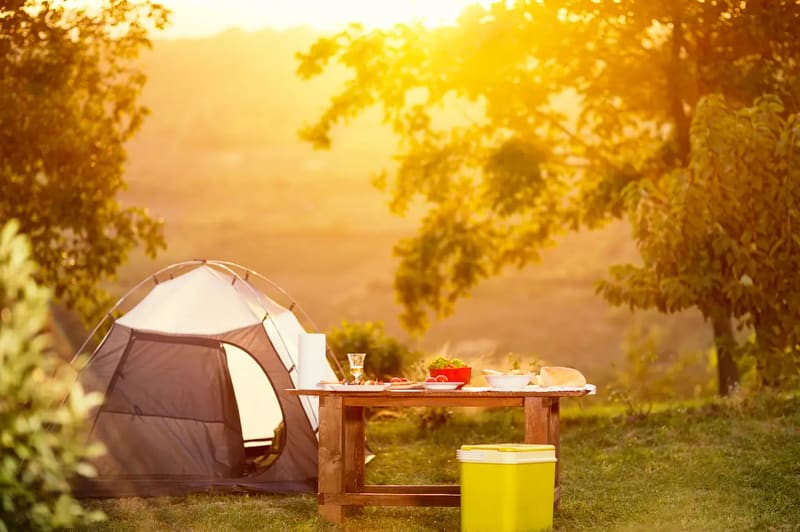
Campfire rules
A campfire is part of the fun, but the rules are strict. In Victoria, the CFA says lighting a fire during a Total Fire Ban is illegal 7. While the Fire Danger Period is in force where you are, a campfire may be lit only if it meets these conditions: it must be in "a properly built fireplace of stone, metal or concrete" or in a trench at least 30 cm deep, and it must be no larger than one metre by one metre 7. The wind must be under 10 km/h 7. Three metres around and above the fire must be clear of anything that can burn, and someone must be awake and alert near the fire at all times 7. Put it out completely with water before you leave, never with soil, because embers can smoulder under soil and start burning again later 7. In a national or state park, the CFA says a campfire can only be lit in the purpose-built fireplaces the park provides, so a trench is not an option there 7.
Those are Victoria's rules, set out on the CFA's campfire page 7. Wherever you camp, check the park's own rules too, and in other states the fire service's rules, before you light a fire.
Free activities for children
Some of the best activities for children cost you only the drive to get there.
Junior Rangers
Parks Victoria's Junior Rangers activities are free to join and are designed for primary school aged children 8. They are led by a Parks Victoria ranger, they run in parks across Victoria during the school holidays, and you book them by creating a profile 8. Parks Victoria also has activity books to download for children who want to learn more about culture and nature across Victoria 8.
Junior parkrun
Parks Victoria says Westerfolds parkrun is one of only a handful of parkruns in Australia to hold a junior parkrun each Sunday morning, for children aged 4 to 14, and that parkrun events are staffed by volunteers 9. So a junior parkrun is not on offer near every campsite: check before you plan a Sunday around one. The 5 km parkrun on Saturday mornings is free too, and walkers are welcome, so the whole family can take part 9.
National parks
Entry to NSW national parks on foot or by push bike is free, and where a park asks for a vehicle entry payment, it is per vehicle rather than per person 10. A carload of children costs no more to bring in than a carload of adults 10.
On a family walk, the NSW National Parks and Wildlife Service advises telling family or friends where you are going and when you expect to return, and carrying at least 2 litres of water per person 11. Choose a walk that the youngest child can finish, and turn back early if anyone is tired.
Pack for days out and stay sun safe
Pack food and water for every day out, so you buy only what you planned to. Fresh water is the best drink for keeping the body hydrated, because it contains no kilojoules 12. Water loss can increase in hot weather and with prolonged exercise 12. Thirst and dizziness are among the symptoms of dehydration 12, so offer children a drink before they ask for one. A refillable bottle for each child saves buying drinks on the way.
Cancer Council Australia recommends sun protection whenever UV levels reach 3 or higher 13. It suggests clothing that covers as much skin as possible, such as collared shirts with long sleeves, and shade from trees or built shelters, or shade you bring yourself, such as a sunshade tent 13. Apply sunscreen to clean, dry skin at least 20 minutes before going outside, and reapply it every two hours or after swimming or heavy sweating 13. Cancer Council says sunglasses and a broad-brimmed hat worn together can cut the UV radiation reaching the eyes by up to 98 per cent, and its SunSmart app tells you when you do and do not need sun protection 13.
Put what you save towards one special day out that the whole family will remember. For more ways to stretch the budget on the road, read our guide to touring Australia on a budget, and for ideas on where to go in the colder months, see our family winter holiday destinations.
Sources
- Victorian Government, School term dates and holidays in Victoria, accessed 29 October 2026
- NSW Department of Education, 2026 term dates, accessed 29 October 2026
- Queensland Government, Camping fees, accessed 29 October 2026
- Parks Victoria, Where to stay, accessed 29 October 2026
- Queensland Government, Towing vehicles and trailers, accessed 29 October 2026
- Food Standards Australia New Zealand, Keeping food at the right temperature, accessed 29 October 2026
- Country Fire Authority, Campfires, accessed 29 October 2026
- Parks Victoria, Junior Rangers, accessed 29 October 2026
- Parks Victoria, Combine nature, running and community through parkrun, accessed 29 October 2026
- NSW National Parks and Wildlife Service, Fee collecting national parks, accessed 29 October 2026
- NSW National Parks and Wildlife Service, Bushwalking safety, accessed 29 October 2026
- Better Health Channel, Victorian Government, Water - a vital nutrient, accessed 29 October 2026
- Cancer Council Australia, Be SunSmart, accessed 29 October 2026
