
Caravan park etiquette mostly comes down to remembering that the people on the next site are on holiday too. The details change from park to park, though. National parks add rules of their own. This guide brings together what park operators, the national parks agencies and other campers say makes a stay go smoothly for everyone.
Other campers are clear about what annoys them. When RAC WA surveyed more than 900 people who had camped or stayed in a caravan in WA in the previous 12 months, leaving rubbish behind at a site was the behaviour they named as the most discourteous 1.
What other campers say bothers them
The RAC Caravan and Camping Survey asked about the behaviour that spoils a stay. Among the people it surveyed:
- 92 per cent rated leaving rubbish behind at a site as very or extremely inconsiderate 1
- 40 per cent often saw children onsite without adult supervision, and more than half rated that very or extremely inconsiderate 1
- 34 per cent regularly saw people leave shower and toilet facilities dirty after use 1
- 31 per cent frequently saw people walk through other people's camp and caravan sites 1
- almost a quarter complained about noisy guests disturbing the peace 1
None of these needs a rule book to fix. Each one comes down to treating the park as a shared place where every site is someone's home for the week. The sections below go through them one at a time, with the rules that back them up.
Read the park rules before you arrive
Every caravan park sets its own rules, and they vary. Two government-run examples show the spread:
- The Great Ocean Road Coast and Parks Authority, which runs caravan parks and camping grounds on the Crown land it manages in Victoria, sets park quiet time from 10 pm to 7 am and a speed limit of 5 km/h inside the park 2.
- The Shire of Narrogin's caravan park in WA sets quiet time from 10 pm to 6 am and a speed limit of 10 km/h, which it calls walking pace 3.
- The Authority allows visitors in its parks only between 8 am and 10 pm 2.
Look for the rules on the park's website, or ask for them when you book, because some parks will not take a pet at all 2. The Authority's caravan park rules are a good example of how much detail a park can set out, and most of what follows draws on them.
Caravan park etiquette on your own site
A site's boundary is the line that matters most. In the Authority's parks, everything you bring has to fit inside your site, and the rules spell out that this includes the drawbar and the guy ropes 2. Access through an occupied site is restricted to the people staying on it, so walk around a neighbour's site, never through it 2. The same rules cap a site at six occupants, no more than four of them adults, not counting infants 2.
If your site is powered, run one lead, not a chain of them. The Authority requires a single length of 15 amp double insulated extension lead to the power head, laid so that it does not obstruct or endanger people walking past 2.
Grey water and barbecues
Grey water may go on the grass in reasonable quantities in the Authority's parks, but only as its staff direct 2. Keep soap and detergent at least 50 metres from any waterway in a national park 5.
Fires are not allowed in the Authority's parks at any time, and neither are solid fuel barbecues of the kettle or heat bead type, although portable LPG barbecues and cook tops are 2. Do not dig holes or trenches either: its rules ban soil disturbance deeper than 100 mm, other than tent pegs, without the manager's approval 2.
Quiet hours and generators
Sound carries in a caravan park, and quiet hours are when your neighbours notice it most. In both parks above, quiet time starts at 10 pm 23. Music, a television in the annexe and late conversations outside all count, so bring the party inside or wind it down before then.
National parks ask for the same courtesy all day. NSW National Parks and Wildlife Service asks visitors to avoid playing music or operating machinery in a way that affects other visitors' enjoyment or disturbs wildlife 5.
Generators need extra care. Under NSW National Parks' generator rules, they are allowed, with restrictions, only in some designated campgrounds, and some parks have noise curfews that apply to them 4. Only one generator may be used per group, and it should sit closer to your own camp than to anyone else's 4. NPWS also says never to run a generator during a fire ban 6. In a caravan park, check the rules before you pack one, because a powered site may make it unnecessary.
Shared amenities and rubbish
The amenities block is where good manners show. Leave the shower and the toilet the way you would want to find them, and tell the office if something is broken or blocked. The Authority's rules add specifics:
- infants and children under seven must be with an adult when they use the amenities 2
- laundry and bathroom sinks are not for washing dishes 2
- fish may not be cleaned in any amenity 2
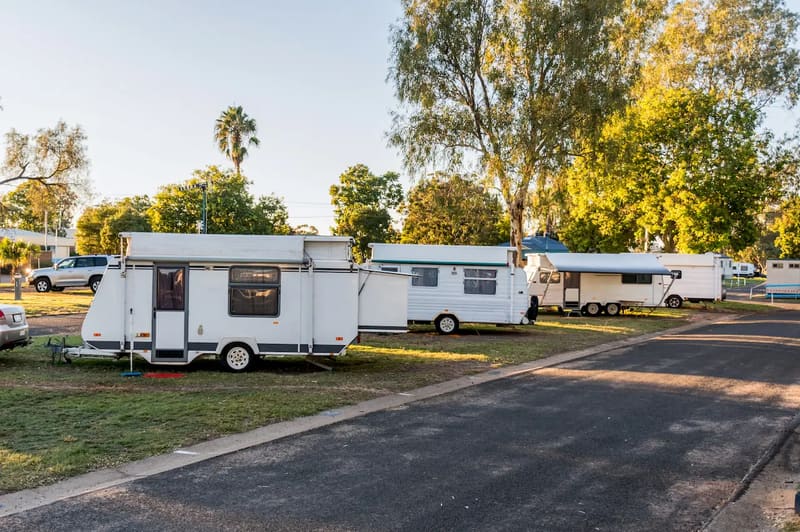
The Authority's parks put out bins for rubbish and recycling. Use them where they are, and do not move them 2. National park campgrounds work differently. Parks Victoria's rangers say bins are not provided at its campgrounds, so be ready to take all your rubbish home rather than leave it in the nearest town 7. NSW National Parks asks visitors to use the bins or, better still, take their rubbish with them 5. Never use a campfire to burn rubbish 6.
Where a campground has no toilets, Parks Victoria's rangers say you will need a chemical toilet and a dump station to empty it 7.
Keeping an eye on kids and pets
Unsupervised children came up often in the RAC survey: 40 per cent of respondents often saw children onsite without an adult, and more than half rated it very or extremely inconsiderate 1. Parks are great places for kids, but someone should always know where they are. Take extra care near roads and water.
Bikes and scooters are part of park life, and they come with rules. In the Authority's parks they may be ridden in daylight hours away from the park entry and exit, a helmet must be worn at all times, and the speed limit of 5 km/h applies to them too 2.
Pets need checking before you book. The Authority's parks do not allow animals unless an exemption is listed on the park's website 2. NSW National Parks says domestic animals pose a danger to native animals and other visitors and are not permitted in most NSW national parks, and asks you to leave your pet with a friend or family member 6. Parks Victoria's rangers say many parks do not allow dogs, and that where dogs are allowed, they should be kept on a leash 7.
Travelling with children? Our tips on family camping on a budget and the family bunk caravans listed on Caravan Domain are good places to start.
Campfires and wildlife
Fire rules are strict and change with the conditions. In Victoria, campfires are not allowed on Total Fire Ban days and heavy penalties apply 8. Where a fire is allowed, Victoria's campfire rules are to clear at least three metres around it of anything that could catch fire, never leave it unattended, and put it out with water, not soil 8. A purpose-built fireplace is the safest option 8.
In NSW national parks, keep fires to a minimum and leave dead wood where it lies: it is habitat for native animals, so NPWS asks campers not to break branches or use fallen timber 5.
Feeding wildlife does harm, however friendly the visitor at your table. NPWS asks visitors not to feed native animals and to store food and rubbish in secure containers away from them 5, and warns that wild animals can become aggressive if they are fed 6. Parks Victoria's rangers put it simply: human food can harm wildlife 7.
Leave No Trace's seven principles, in the version held by the library of Western Australia's parks department, sum up most of this guide 9:
- Plan ahead and prepare.
- Walk and camp on durable surfaces.
- Dispose of waste properly.
- Leave what you find.
- Minimise campfire impacts.
- Respect wildlife.
- Be considerate of your hosts and other visitors.
Arriving and leaving without fuss
Reversing onto a site worries plenty of people. In the RAC survey, nearly one in three respondents were not confident reverse parking, and 22 per cent had done no research or training before they started towing 1. If that sounds like you, ask for a drive-through site when you book, and practise reversing in an empty car park before the trip. If you are still choosing a van, Caravan Domain's tow match tool shows the caravans your vehicle can tow.
Arrive inside the park's check-in window, and call ahead if you will be late so the office can plan for you. Sites at the Shire of Narrogin's park are available from 11 am, and check-out is by 10 am 3. If you need longer on the last morning, ask. Accept a no with good grace in a busy period.
Book ahead for busy periods, national parks included. NSW National Parks says you may need to book in advance to stay at one of its campgrounds 6, and Parks Victoria's rangers advise booking ahead to avoid disappointment 7.
When you leave, take everything you brought with you, rubbish included. Leave the site ready for the next arrivals. Then plan the next trip: our list of bucket-list caravan trips covers the permits and seasons for trips from Tasmania to the Kimberley.
Sources
- RAC WA, Campers and Caravanners Call Out Bad Behaviour, accessed 29 October 2026
- Great Ocean Road Coast and Parks Authority, Caravan parks and camping grounds rules, accessed 29 October 2026
- Shire of Narrogin, Caravan Park Terms and Conditions, accessed 29 October 2026
- NSW National Parks and Wildlife Service, Generators when camping, accessed 29 October 2026
- NSW National Parks and Wildlife Service, Considerate camping, accessed 29 October 2026
- NSW National Parks and Wildlife Service, Camping safety in national parks, accessed 29 October 2026
- Parks Victoria, Going camping? Our rangers give us the low down, accessed 29 October 2026
- Victorian Government, Campfires, stoves and BBQs, accessed 29 October 2026
- Department of Biodiversity, Conservation and Attractions (WA) library, 7 Principles of Leave No Trace for walkers, accessed 29 October 2026
