
Park a mobile home next to a touring caravan and you would struggle to see a family resemblance. One is wide, boxy and plugged into the ground. The other is narrow, curved and ready to be hitched to a tow bar by the weekend. Yet mobile homes and caravans share the same historic origins, and for a few decades they were the same product sold to the same sort of customer.
So what happened? The short answer is that the split was less about engineering than about what owners wanted to do with the thing. One group wanted to go somewhere. The other wanted to stay.
Same trailer, same early customers
In the United States, the housing form we now call a mobile home goes back to the early years of cars and motorised highway travel. It was derived from the travel trailer, which in those early years was often called a "house trailer" or "trailer coach". These were small units with wheels attached permanently, used for camping or extended travel.
The original rationale was mobility, plain and simple. According to Wikipedia's entry on mobile homes, the units were first marketed mainly to people whose lifestyle required them to move around. Nobody was selling a trailer as a place to sit still.
The word "caravan" itself has older roots. Wikipedia's history of the caravan trailer traces European caravanning back to the travelling Romani people and to showmen who spent most of their lives in horse-drawn caravans. It credits the Bristol Wagon & Carriage Works with building the first leisure trailer in 1880, for the author William Gordon Stables. He called it Wanderer, toured the British countryside in it and wrote a book about the trips in 1885. The Caravan Club followed in 1907, with Stables as its vice president.
Across the Atlantic, caravanning gained popularity in North America in the 1920s. Early owners there were nicknamed "tin can tourists". By the 1930s and 1940s the trailers had become more liveable and earned the name house trailer.
The 1950s fork in the road
The sources agree on when it happened. In the 1950s and 1960s, as the caravan history puts it, the American industry "seemed to split" into the two types we see today: the recreational vehicle industry and the mobile home industry.
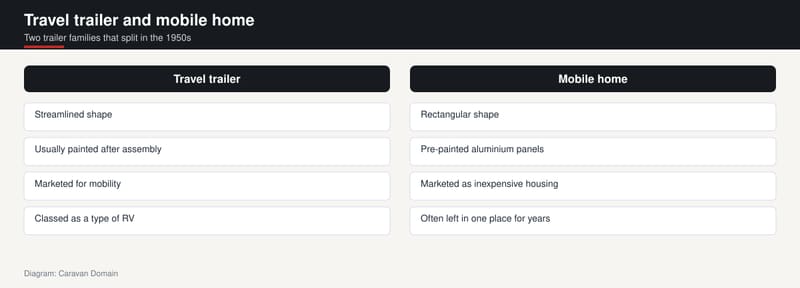
The mobile home side changed its sales pitch first. In the 1950s the homes began to be marketed mainly as an inexpensive form of housing, designed to be set up and left in one place for long periods, or even installed permanently on a masonry foundation. The trailer was no longer a ticket to somewhere else. It was a cheaper way to own a roof.
Then came a bit of branding. Before 1956, units had been eight feet or less in width. That year the ten-foot-wide home, the "ten-wide", arrived, and with it the new term "mobile home". Our view is that the name gave the game away. A product called a mobile home that most owners never moved is a slightly cheeky label, and the market seemed to know it.
The travel trailer people carried on selling freedom. Their trailers stayed light enough to tow, and the industry kept pushing in the direction of touring, with smaller models built so they could be quick to set up and quick to pack away.
How the shape changed
Look at the two machines and the split is written into their bodies. The mobile homes were given a rectangular shape, built from pre-painted aluminium panels. Travel trailers kept the streamlined shape and were usually painted after assembly. That difference in how they were built and finished helped widen the gap between the two.
Width did the rest. The smaller eight-wide units could be moved simply with a car. The ten-wide, and later twelve-wide, usually needed a professional trucking company and often a special moving permit from a state highway department. In the late 1960s and early 1970s the homes grew longer and wider again, which made them harder to shift still further.
Even today, the modern versions come in two main sizes. Single-wides are 18 feet or less in width and 90 feet or less in length, and can be towed to site as one unit. Double-wides are 20 feet or more wide and are towed in two pieces, then joined. Triple-wides and bigger are built less often. One detail we like: factory-built homes tend to have a shallower roof slope than a site-built house, so they can pass under bridges and overpasses on the way to their site.
Strip off the cosmetic work done at installation to hide the base, and the old family tie is still there. A mobile home has a strong trailer frame, axles, wheels and a tow hitch underneath. It just rarely uses them again.
The home that stays put
Here is the number that sums up the divide. Wikipedia reports that only about 5 per cent of all double-wides will ever be moved. Single-wides are traded more often because removing them from the site is easier, usually as a trade-in against a new home, and the used units go on to new owners or to park owners who rent them out cheaply.
Most of these homes sit in land-lease communities, known as trailer parks or mobile home parks, where owners rent the space under their home. The site often provides water, sewer and electricity, plus extras such as pools and community rooms. The source counts over 38,000 of these parks in the United States, ranging from 5 to more than 1,000 home sites. Some are retirement communities that restrict residents to those aged 55 and older. Others are seasonal communities in popular holiday spots.
A newer wrinkle is the park where the owner of the home also owns the lot it sits on. Some of those are run a bit like condominiums, with shared clubhouses and membership fees.
Compare that with a caravan owner pulling into a site for the weekend. Same family, very different relationship with the ground.
When wheels meant tax and loans
Once a trailer stops moving, the law has to decide what it is. That question tangled up the American system for years, and it shows how far the cousins drifted.
Originally, factory-built homes tended to be taxed as vehicles rather than real estate, which meant very low property tax for their occupants. Local governments responded by reclassifying them. In some states a mobile home is taxed as personal property if the wheels remain attached, and as real estate if the wheels are removed. Removing the tongue and axles can also be a requirement for real estate classification. There is also a continuing legal debate about fixtures and chattels, where the status of a trailer can shift depending on how it is joined to the land.
Money followed the same logic. Early homes tended to lose value over time, much like motor vehicles, whereas a site-built house includes land and tends to appreciate. Because of that, loans for mobile homes had shorter terms than the typical thirty years and carried considerably higher interest rates. In the source's words, mobile home loans resembled motor vehicle loans more than traditional mortgages.
Zoning followed too. The rapid arrival of many homes in one area strained water pressure, sewage disposal and roads, and neighbours worried about the effect on existing property values. Many jurisdictions responded with zoning rules, density limits, minimum size requirements and foundation mandates. Some will not allow any additional factory-built homes at all.
Rules, standards and the 1976 line
Regulation drew a harder line again. Mobile homes built in the United States since June 1976 are legally called manufactured homes. They must meet federal certification requirements and carry metal certification tags. The US Department of Housing and Urban Development regulates them under the Federal National Manufactured Housing Construction and Safety Standards Act of 1974, which lets manufacturers sell nationwide without bowing to local building authorities.
Modern units are a long way from their ancestors. Newer homes, particularly double-wides, tend to be built to much higher standards and from materials similar to those used in site-built homes. They also look more like a regular house, and that has slowed the rate at which used units lose value.
Travel trailers sit under a different banner. In the United States they are classed as a type of recreational vehicle, alongside motorhomes, fifth-wheel trailers, pop-up trailers and truck campers. The source notes that by law they are limited to 400 square feet of living area. Safety and towing rules vary by state and country, so if you are weighing up a tow setup, check with your state road authority, and our guide to what your car can tow is a sensible first stop.
What "mobile home" means abroad
Take the term overseas and it wobbles. In many European campgrounds, "mobile home" refers to fixed caravans, purpose-built cabins and even large tents, rented by the week or all year as cheap accommodation. The word is not used widely in Britain.
In the United Kingdom the same idea is split in two. Residential mobile homes are called park homes and are built to the BS3632 standard, issued by the British Standards Institution. Most residential parks there set a minimum age for residents and are marketed as retirement or semi-retirement parks. Holiday versions are known as static caravans or leisure lodges, and need not meet BS3632, though many do.
A static caravan, as the source describes it, has wheels and a rudimentary chassis with no suspension or brakes. It is carried on a large flatbed lorry, and the axle and wheels are used only for the final shuffle onto its plot. It normally stays on one plot for many years. Purchase prices run from £25,000 to £100,000, and the yearly costs of insurance, site fees, rates, utilities, winterisation and depreciation can range from £1,000 to £40,000. The Office of Fair Trading has produced guidance on unfair terms in holiday caravan agreements, because some park owners used to write unfair conditions into leases.
Australia adds its own twist. The caravan history notes that Australian English calls both RV parks and trailer parks "caravan parks". So the word on the gate can cover a very different mix of residents depending on where you are.
Where the cousins still overlap
The split is wide, but not total. Wikipedia's caravan entry says tiny homes that are mobile can have much in common with a caravan, even though going RVing and the tiny home movement are different trends. One is about living mobile or holidaying, the other about living in a small house mostly in one spot. We dug into that border in our look at the tiny house on wheels.
For travellers, the practical takeaway is simple. If you want a base that moves, you are shopping in the touring world, whether that is a hard-sided van, one of the pop-top caravans or a hybrid. You can browse the whole range under caravans and RVs for sale. If you want a place to live that happens to have wheels under it, you are in a different market, with different rules, loans and land arrangements.
Our team reckons the neatest way to see the split is this: both families still carry axles and a tow hitch, but only one of them uses them regularly. The cousins went separate ways, and a mobile home sitting on its block is the one that stayed home for the family dinner.
Sources
- Wikipedia, Mobile home, accessed 14 November 2026
- Wikipedia, Caravan (trailer), accessed 14 November 2026